Industrial felt components · wholesale enquiries
Industrial Felt Strips & Cut-to-Size Polishing Felt
Felt strips are narrow lengths of felt specified by width, thickness, length and material. They can be considered for compound-polishing contact, surface protection, wiping or cushioning enquiries when the grade and installation are selected for the job. Request cut pieces or a defined roll format with the dimensions and acceptance requirements your order needs.
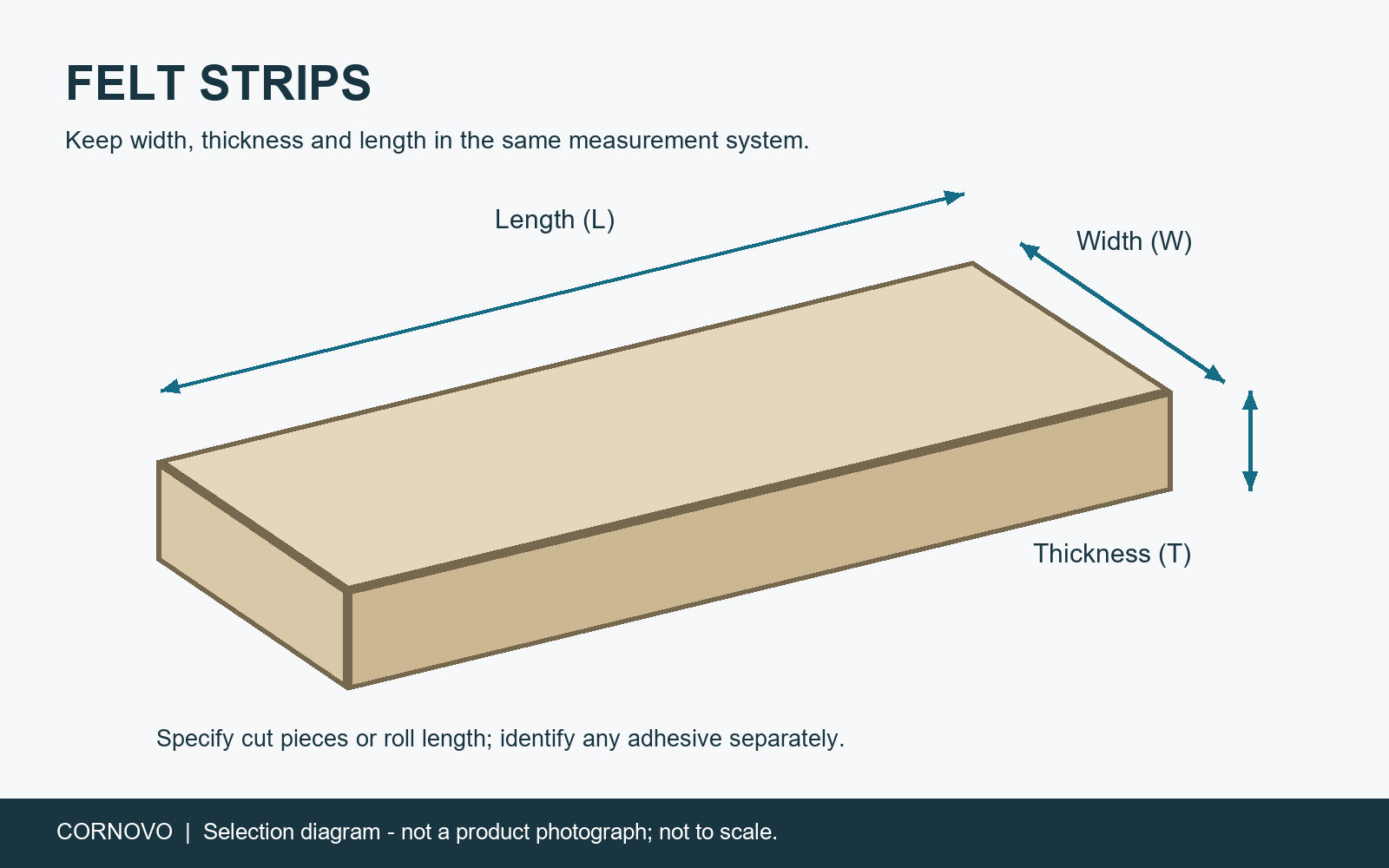
Use the strip dimensions to define the contact
Width determines the contact band, thickness affects the fit in a holder or gap, and length determines the piece or roll you receive. Keep those measurements separate. For a slotted holder, provide the holder drawing and how the felt is retained. For a shaped contact area, include the required profile or compare a custom felt component instead of ordering an unspecified straight strip.
Polishing felt strips and general-purpose strips are different enquiries
A strip intended to carry polishing compound needs to be evaluated with the workpiece, starting condition and target finish. A strip used for wiping or cushioning needs a different sample check. Describe the intended function rather than relying on a generic wool-felt label. Do not assume that a craft strip or furniture-protection strip has the construction required for an industrial process.
Specify grade and construction without guessing from colour
Ask for the actual fibre composition and material designation. Provide density, firmness or an accepted reference sample where those characteristics matter. Identify whether the material must be plain, backed, adhesive-coated or supplied in another construction. If the existing sample has absorbed oil or has been compressed in service, explain that condition so it is not mistaken for an unused material specification.
Specification checklist for your quotation
| Selection item | What to specify |
|---|---|
| Width × thickness × length | State the dimensions, units and tolerances; distinguish strip width from roll length. |
| Material | Fibre composition, construction, requested grade and density/firmness reference. |
| Cut format | Individual straight pieces, rolls or a drawing-defined profile; state continuous-length requirements. |
| Backing / adhesive | Plain or a separately specified backing/adhesive request, including mating surface and liner. |
| Installation | Holder, gap, contact area, retention method and operating movement. |
| Application | Workpiece and compound for polishing, or the exact wiping, protection or cushioning requirement. |
| Order unit | Per piece, per metre or per defined roll, with pack quantity and identification. |
This is an enquiry range. No universal size, material percentage, operating rating, stock availability or fixed MOQ is implied. Confirm the exact item in the written quotation.
Application scenarios and sample checks
Use the intended application to define the sample trial. The examples below are selection discussions, not blanket performance approvals.
| Enquiry | Information to provide | What the trial should check |
|---|---|---|
| Compound-polishing contact | Slot or profile, workpiece material, compound and initial surface condition. | Compare access, contact marks, finish and residue on a representative part. |
| Wiping or lubricant-contact enquiry | Contact surface, lubricant or contamination, movement and installation. | Review compatibility and inspect the agreed wiping or transfer function. |
| Cushioning / surface protection | Gap, contact materials, compression, handling and any adhesive requirement. | Check fit, retention and surface marking under the intended conditions. |
Adhesive-backed strips need a complete bonding specification
Tell us the mating surface and whether the strip is placed by hand or through an assembly process. Request the adhesive designation, liner, application and storage instructions for the proposed supply. Thickness should be identified as felt-only or total assembly thickness. Do not compare an adhesive-backed quotation with plain felt solely by the price per metre.
Confirm how pieces and rolls are counted
A narrow roll is often described using width and length, while a cut strip needs three dimensions. State whether joints are permitted and whether every cut piece needs a label or grouped packing. For repeat orders, keep the same order unit on the enquiry, quotation, purchase order and carton label. That prevents a price per piece from being mistaken for a price per metre.
Approve fit and performance before standardising a strip
Inspect dimensions using the agreed measuring method, then check cut edges and material identification. Fit a sample to the actual holder or assembly and assess it with the intended workpiece and consumables. Record the outcome and retain the sample reference. If backing, felt grade or thickness changes, review the effect instead of accepting the substitute because its width is unchanged.
Frequently asked purchasing questions
What measurements are needed for a felt strip?
Specify width × thickness × length and the measurement units. For rolls, state required width, thickness, length per roll and whether joints are acceptable.
Can I order plain strips and adhesive-backed strips together?
List them as separate variants, with quantities and the complete backing/adhesive requirements. Availability, packing and price are confirmed for each construction.
Are felt strips suitable for polishing every material?
No universal suitability is claimed. Identify the workpiece, coating, compound and finish target, then evaluate the proposed felt grade in a representative trial.
Is a cut felt strip the same as felt cord?
A strip normally has separately specified width and thickness; a round cord is specified by diameter. Confirm the actual cross-section and use the matching drawing rather than treating the names as interchangeable.
Should thickness be measured before or after compression?
State the measurement condition required by your drawing or application. Agree the method with the supplier so sample and delivery measurements can be compared.
What should a bulk enquiry include?
Send dimensions, material reference, plain or backed construction, use, quantity by variant, pack format and destination. Request sample terms, MOQ, price basis, currency and lead time in writing.
Send an enquiry that can become a clear purchase order
Send the drawing or reference sample, material requirements, quantities by variant and destination. Ask the quotation to confirm the sample specification, order unit, MOQ, unit price and currency, quotation validity, packing, lead time and delivery basis. Separate any tooling, sample, adhesive, packaging and freight charges so you can compare the complete proposed supply.
Before confirming repeat production, retain the accepted sample, drawing revision and written inspection requirements. Include the delivery destination and any label or barcode requirements.
Send dimensions and request a quote
Email: sales@cornovoabrasive.com · WhatsApp +86 186 1817 1069
Compare related felt formats
ORDER PLANNING
Wholesale Order & Carton Calculator
Estimate goods value, carton count and packed volume using your own quoted price and confirmed packing data. For sets or rolls, use the same order unit for quantity, price and units per carton.
Cartons = quantity ÷ units per carton, rounded up. Goods value = quantity × unit price. Volume = cartons × outer length × width × height ÷ 1,000,000 (cm to m³). The final partial carton uses the same outer dimensions. This is an estimate, not a quotation or customs calculation.
Enable JavaScript to use the calculator, or send your quantity and carton information with your inquiry.