Industrial felt components · wholesale enquiries
Industrial Felt Cord & Wool Felt Rope
Felt cord is a narrow, flexible felt component specified by its cross-section, material and supplied length. For polishing work, it provides a contact form for a selected compound; wicking or dust-contact applications require their own material and performance checks. Send Cornovo the exact geometry, use and order quantity for a product-specific quotation.
Start with the job: polishing cord or a functional felt component?
A request for felt rope can mean several different products. A buyer finishing a narrow groove needs to describe access, the workpiece and the compound. A maintenance team replacing a lubricant wick needs to identify the existing material, lubricant and installation. A decorative craft cord is another category. Naming the intended job first prevents a visually similar cord from being quoted for an unrelated purpose.
Define the cross-section before choosing the length
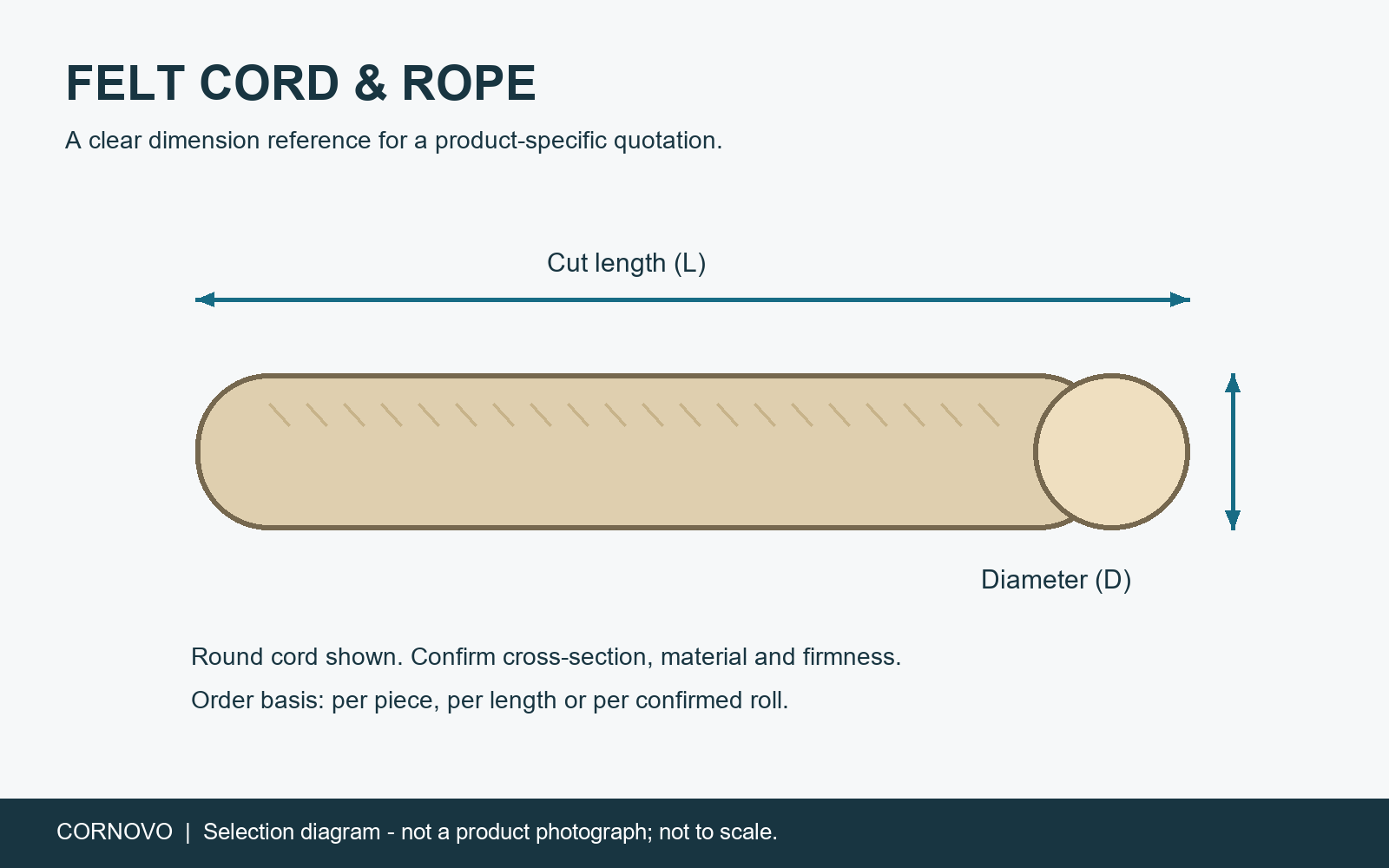
Confirm whether the required section is round, rectangular or a custom profile. For round cord, give the nominal diameter and the permitted variation. For a rectangular section, state width and thickness separately and compare our felt strips page. Identify whether dimensions are measured in the free state or under an agreed compression. A soft sample can give different readings when a measuring tool is pressed more firmly.
Material and firmness belong on the order line
The phrase wool felt rope does not by itself establish wool content, density, firmness or manufacturing construction. Provide an existing material designation or reference sample when available. For a replacement, tell us which characteristics must stay the same and which may be evaluated as alternatives. Do not substitute braided yarn, an open fibre bundle or a different felt grade solely because its diameter looks similar.
Specification checklist for your quotation
| Selection item | What to specify |
|---|---|
| Cross-section | Round diameter, or width × thickness for another profile; state units and tolerance. |
| Supplied length | Cut length per piece or confirmed roll length, plus the permitted number of joints if relevant. |
| Material | Requested wool content or other fibre composition, felt construction and reference grade. |
| Firmness / density | Supplier designation or agreed test/reference sample; avoid selecting by colour alone. |
| Installation | Holder or groove dimensions, method of retaining the cord, movement and contact conditions. |
| Application | Workpiece and compound for polishing; lubricant and equipment details for a wicking enquiry. |
| Supply unit | Price per metre, per cut piece or per defined roll; state the matching pack quantity. |
This is an enquiry range. No universal size, material percentage, operating rating, stock availability or fixed MOQ is implied. Confirm the exact item in the written quotation.
Application scenarios and sample checks
Use the intended application to define the sample trial. The examples below are selection discussions, not blanket performance approvals.
| Enquiry | Information to provide | What the trial should check |
|---|---|---|
| Detail polishing | Accessible groove or curved profile, starting finish, intended compound and handling method. | Compare contact, finish and residue on a representative component. |
| Lubricant-wicking enquiry | Existing wick dimensions, lubricant, feed arrangement and equipment requirements. | Confirm compatibility and the required transfer behaviour for the chosen material. |
| Cushioning or dust-contact enquiry | Gap, movement, compression, environment and required service conditions. | Check fit, retention and the agreed function in the actual assembly. |
Cut lengths and rolls need different purchasing checks
A metre of cord, a one-metre cut piece and a roll are different order descriptions. State whether every piece must be continuous, how ends should be finished and how lengths should be identified. For mixed sizes, use one line for each diameter and material combination. Confirm whether the quoted quantity is pieces, length or rolls before comparing unit prices.
Approve the sample against a written reference
First check the cross-section, length, visible fibre condition and identification. Then assess it in the intended holder or process using the agreed workpiece and consumables. Record what you measured, the test conditions and the acceptance result. Retain an approved sample and its specification so a repeat order is more than a request for the same white cord.
Frequently asked purchasing questions
Is felt cord the same as ordinary wool yarn?
No equivalence is established by the name or appearance. Specify the actual felt construction and material. Yarn, roving and technical felt cord may behave differently in the same holder or process.
Can the same cord be used for polishing and oil wicking?
Do not assume that one grade meets both needs. Polishing selection depends on the contact and compound; a wicking enquiry also needs lubricant compatibility and transfer requirements.
Can I request cut lengths instead of a roll?
Include the required length per piece, number of pieces and end requirements in the enquiry. Availability, tolerances and packing are confirmed for the proposed supply.
Which diameter should I order?
Use a drawing, measured groove or an identified replacement sample. Confirm the measurement method and intended compression; no universal diameter follows from the application name.
What information is needed for a quote?
Send cross-section, length, material/reference grade, use, quantity by variant and destination. Include a photograph or drawing and any packaging or labelling requirements.
Are the picture and dimensions a fixed stock specification?
The dimension guide is an original selection illustration, not a photograph of stock. Actual construction, dimensions, price, MOQ and lead time are confirmed in the quotation.
Send an enquiry that can become a clear purchase order
Send the drawing or reference sample, material requirements, quantities by variant and destination. Ask the quotation to confirm the sample specification, order unit, MOQ, unit price and currency, quotation validity, packing, lead time and delivery basis. Separate any tooling, sample, adhesive, packaging and freight charges so you can compare the complete proposed supply.
Before confirming repeat production, retain the accepted sample, drawing revision and written inspection requirements. Include the delivery destination and any label or barcode requirements.
Send dimensions and request a quote
Email: sales@cornovoabrasive.com · WhatsApp +86 186 1817 1069
Compare related felt formats
ORDER PLANNING
Wholesale Order & Carton Calculator
Estimate goods value, carton count and packed volume using your own quoted price and confirmed packing data. For sets or rolls, use the same order unit for quantity, price and units per carton.
Cartons = quantity ÷ units per carton, rounded up. Goods value = quantity × unit price. Volume = cartons × outer length × width × height ÷ 1,000,000 (cm to m³). The final partial carton uses the same outer dimensions. This is an estimate, not a quotation or customs calculation.
Enable JavaScript to use the calculator, or send your quantity and carton information with your inquiry.